
Creates an `iglm.data` object, which stores network and attribute data. This function acts as a user-friendly interface to the `iglm.data` R6 class generator. It handles data input, infers parameters like the number of units (`n_units`) and network directedness (`directed`) if not explicitly provided, processes network data into a consistent edgelist format, calculates the overlap relation based on an optional neighborhood definition, and performs extensive validation of all inputs.
Usage
iglm.data(
  x_attribute = NULL,
  y_attribute = NULL,
  z_network = NULL,
  neighborhood = NULL,
  directed = TRUE,
  n_units = NA,
  family_x = "binomial",
  family_y = "binomial",
  scale_x = 1,
  scale_y = 1,
  fix_x = FALSE,
  fix_z = FALSE,
  fix_z_alocal = FALSE,
  return_neighborhood = TRUE,
  file = NULL,
  label_x = "x",
  label_y = "y",
  label_z = "z",
  n_actor = NULL
)
Arguments
- x_attribute
A numeric vector for the first unit-level attribute.
- y_attribute
A numeric vector for the second unit-level attribute.
- z_network
A matrix representing the network. Can be a 2-column edgelist or a square adjacency matrix.
- neighborhood
An optional matrix for the neighborhood representing local dependence. Can be a 2-column edgelist or a square adjacency matrix. A tie in `neighborhood` between unit i and j indicates that j is in the neighborhood of i, implying dependence between the respective units.
- directed
A logical value indicating if `z_network` is directed. If `NA` (default), directedness is inferred from the symmetry of `z_network`.
- n_units
An integer for the number of units in the system. If `NA` (default), `n_units` is inferred from the attributes or network matrices.
- family_x
Character string for the family of `x_attribute`. Must be one of `"binomial"`, `"poisson"`, or `"normal"`. Default is `"binomial"`.
- family_y
Character string for the family of `y_attribute`. Must be one of `"binomial"`, `"poisson"`, or `"normal"`. Default is `"binomial"`.
- scale_x
A positive numeric value for scaling (e.g., variance for "normal" type). Default is 1.
- scale_y
A positive numeric value for scaling (e.g., variance for "normal" type). Default is 1.
- fix_x
(logical) If `TRUE`, the 'x' predictor is held fixed during estimation/simulation (fixed design in regression). Default is `FALSE`.
- fix_z
(logical) If `TRUE`, the 'z' network is held fixed during estimation/simulation (fixed network design). Default is `FALSE`. Setting this to TRUE, allows practitioners to estimate autologistic unit attribute models, which were introduced in binary settings in Daraganova, G., & Robins, G. (2013).
- fix_z_alocal
(logical) If `TRUE`, edges outside the overlap region are fixed, else they are random (default).
- return_neighborhood
Logical. If `TRUE` (default) and `neighborhood` is `NULL`, a full neighborhood (all dyads) is generated implying global dependence. If `FALSE`, no neighborhood is set.
- file
(character) Optional file path to load a saved `iglm.data` object state.
- label_x
Character string for the label/name of `x_attribute`. Default is `"x"`.
- label_y
Character string for the label/name of `y_attribute`. Default is `"y"`.
- label_z
Character string for the label/name of `z_network`. Default is `"z"`.
- n_actor
(Deprecated) An integer for the number of units. Please use
n_unitsinstead.
References
Fritz, C., Schweinberger, M. , Bhadra S., and D. R. Hunter (2025). A Regression Framework for Studying Relationships among Attributes under Network Interference. Journal of the American Statistical Association, to appear.
Daraganova, G., and Robins, G. (2013). Exponential random graph models for social networks: Theory, methods and applications, 102-114. Cambridge University Press.
Examples
# \donttest{
data("state_twitter")
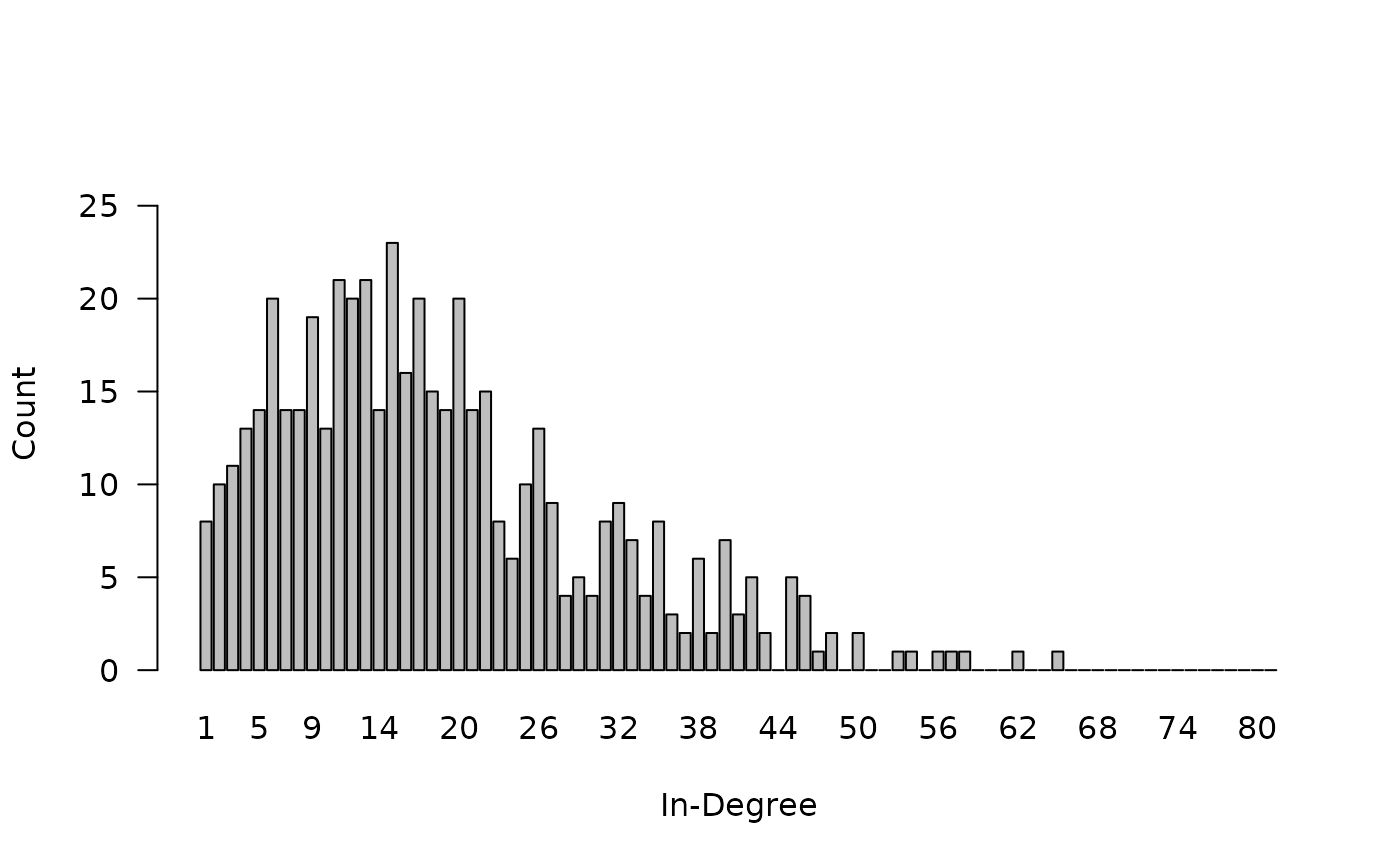
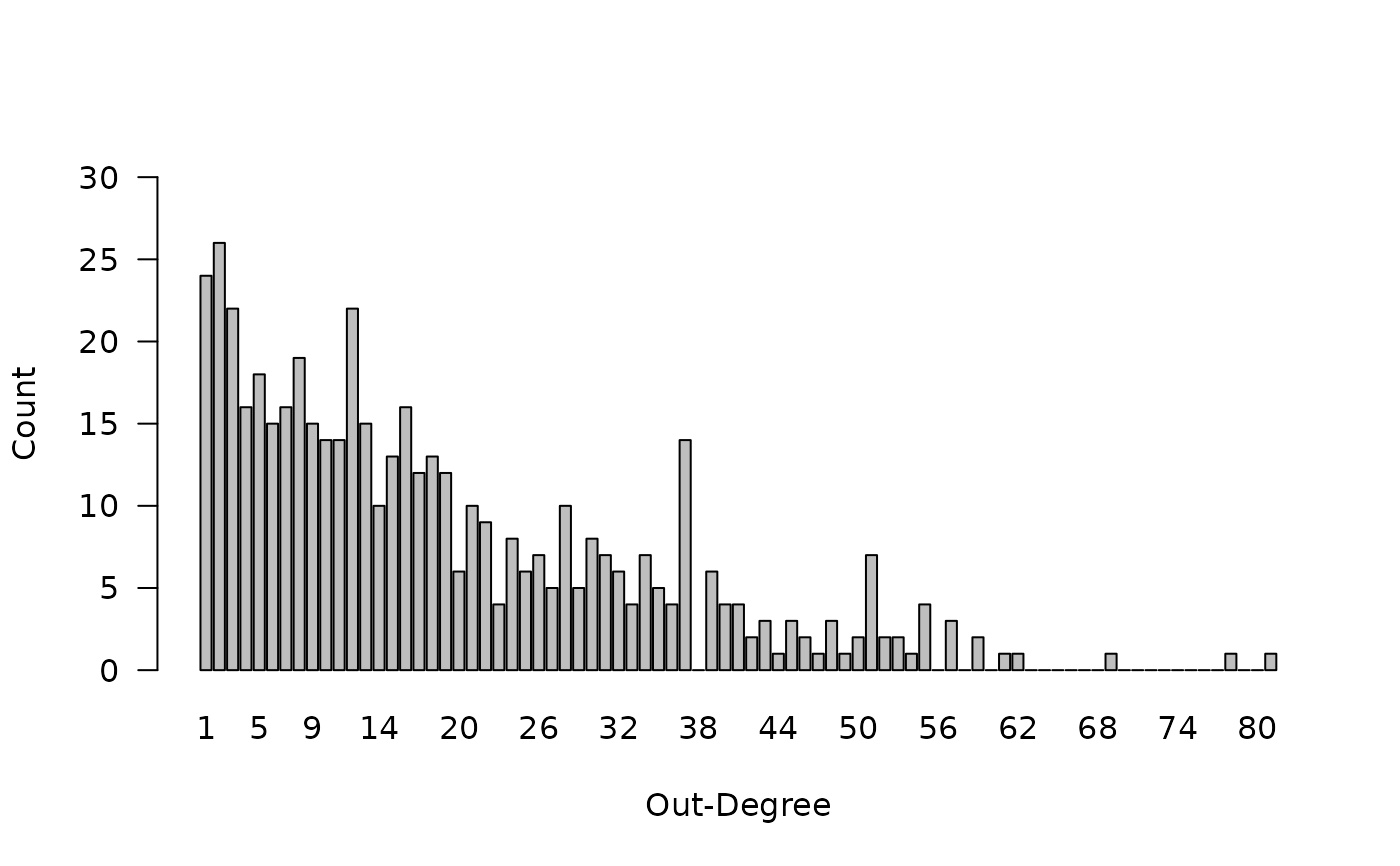
state_twitter$iglm.data$degree_distribution(prob = FALSE, plot = TRUE)
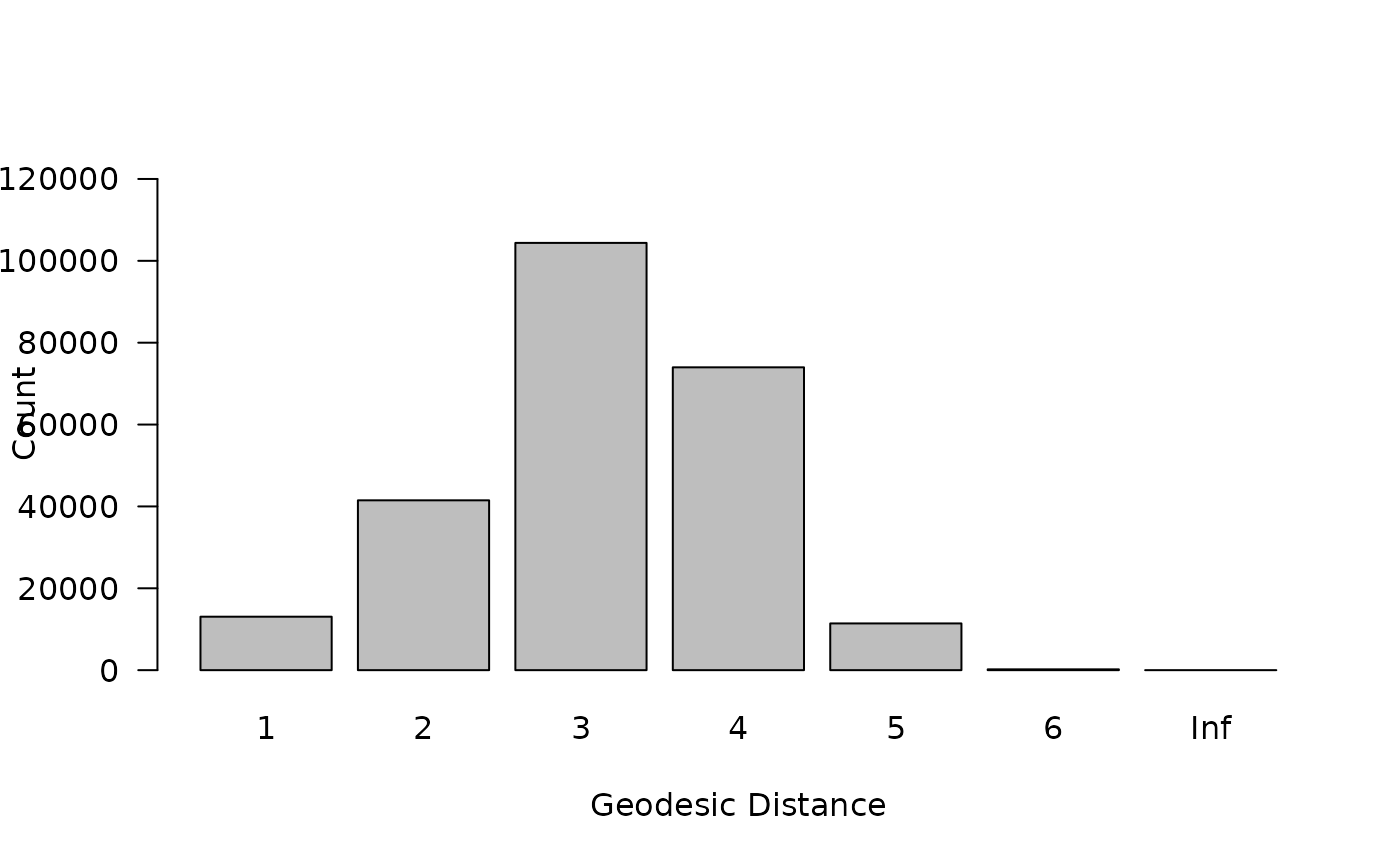
 state_twitter$iglm.data$geodesic_distances_distribution(prob = FALSE, plot = TRUE)
 state_twitter$iglm.data$mean_x()
#> [1] 0.3939394
state_twitter$iglm.data$mean_y()
#> [1] 0.4121212
# }
# Generate a small iglm data object either via adjacency matrix or edgelist
tmp_adjacency <- iglm.data(
z_network = matrix(c(
0, 1, 1, 0,
1, 0, 0, 1,
1, 0, 0, 1,
0, 1, 1, 0
), nrow = 4, byrow = TRUE),
directed = FALSE,
n_units = 4,
family_x = "binomial",
family_y = "binomial"
)
tmp_edgelist <- iglm.data(
z_network = tmp_adjacency$z_network,
directed = FALSE,
n_units = 4,
family_x = "binomial",
family_y = "binomial"
)
tmp_edgelist$mean_z()
#> [1] 0.6666667
tmp_adjacency$mean_z()
#> [1] 0.6666667